 By
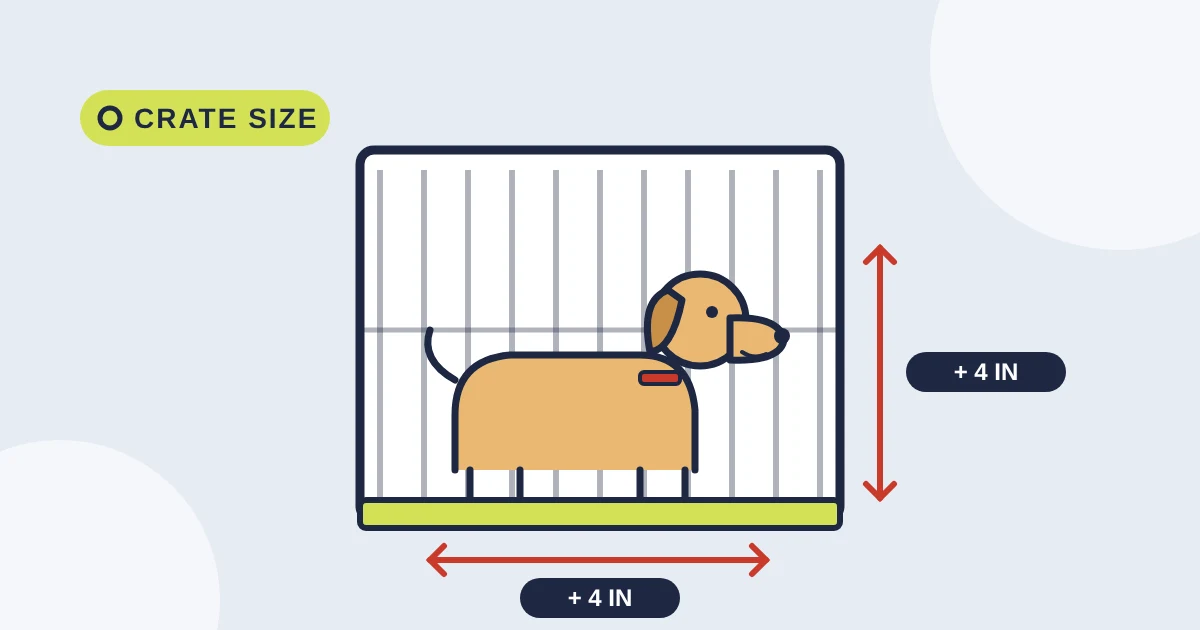
Short answer: measure your dog standing, from the tip of the nose to the base of the tail, and from the floor to the top of the head. Add about 4 inches to each. The crate’s length and height must be at least those numbers. Most dogs land in one of seven standard sizes: 18, 22, 24, 30, 36, 42 or 48 inches. Use weight only as a cross-check, and for a puppy, buy the adult size and close it down with a divider.
A note from Helen: Teya, our Pomeranian, is a small dog with a big coat, a good reminder that a weight chart can’t see coat, legs or build. This guide isn’t a test of crates at home. The sizing comes from the American Kennel Club, a vet-reviewed PetMD chart and MidWest’s listed crate dimensions; the time limits come from PAWS Chicago; and the warnings come from about 75 recent critical owner reviews of five popular crates.
How to measure your dog for a crate
- Length: with your dog standing, measure from the tip of the nose to the base of the tail (not the tip of the tail).
- Height: with your dog standing, measure from the floor to the top of the head. If the ears stand up, measure to the ear tips.
- Add room: the AKC says to add 3 to 4 inches to each measurement; Amazon’s own crate listings say 4. We use 4 inches.
- Check the result: PetMD’s vet-reviewed guide says your dog should be able to stand up with ease, have at least 2 inches above the head when sitting, and fully stretch out the legs when lying on one side.
Don’t size by weight alone. PetMD says to base crate size on your dog’s measurements, not weight or breed. A long, low Dachshund and a leggy Whippet can weigh the same and need different crates. In the owner reviews we read, several “too small” complaints came from people who went by a weight chart or a photo instead of a tape measure.
Crate size calculator
What size crate does your dog need?
Enter your dog’s measurements in inches. Everything runs in your browser.
Sizes and links use MidWest iCrate listed outside dimensions; wire crates lose a little inside, which the 4-inch allowance covers.
Dog crate size chart
Dog length and height limits come from PetMD’s vet-reviewed chart; crate dimensions and weight ranges come from MidWest’s iCrate listings. When length, height and weight point to different sizes, go with the larger.
| Crate | Listed size (L × W × H, in) | Dog length | Dog height | Typical weight | Example breeds | Shop |
|---|---|---|---|---|---|---|
| 18″ | 18.5 × 12.5 × 14.5 | Up to 10 in | Up to 10 in | Up to about 10 lb | Toy puppies, Maltese, Japanese Chin | iCrate 18″ |
| 22″ | 22.5 × 13.5 × 16 | Up to 16 in | Up to 12 in | Up to about 15 lb | Chihuahua, Yorkie, Pomeranian, Papillon | iCrate 22″ |
| 24″ | 24.5 × 17.5 × 19.5 | Up to 18 in | Up to 14 in | 12–25 lb | Pug, Shih Tzu, Bichon, Havanese | iCrate 24″ |
| 30″ | 30.5 × 19.25 × 21.5 | Up to 24 in | Up to 18 in | 21–40 lb | French Bulldog, Dachshund, Corgi, Boston Terrier | iCrate 30″ |
| 36″ | 36.5 × 23.25 × 24.75 | Up to 30 in | Up to 20 in | 41–70 lb | Beagle, English Bulldog, Australian Cattle Dog | iCrate 36″ |
| 42″ | 42.5 × 28.5 × 30.5 | Up to 36 in | Up to 24 in | 71–90 lb | Labrador, Golden Retriever, Boxer, Aussie | iCrate 42″ |
| 48″ | 48.5 × 30.25 × 32 | Up to 42 in | Up to 26 in | 90–110 lb | German Shepherd, Husky, Collie | iCrate 48″ |
Bigger than 48 inches? Giant breeds such as Great Danes and Mastiffs need a 54-inch crate or larger; measure them the same way.
Wire, plastic, soft, furniture or heavy-duty?
| Type | Best for | Watch out for |
|---|---|---|
| Folding wire | Most dogs and puppies: airflow, a divider, folds flat. The AKC calls metal crates the sturdiest you can buy. | Paws and jaws can catch in gaps and latches; check welds and edges. |
| Plastic | Dogs who like a den, and travel: the AKC notes plastic crates double as travel carriers. | Less airflow; check airline size rules separately. |
| Soft (fabric) | Calm, small dogs for short stays and travel; the AKC calls them economical for small dogs who won’t chew. | Not for chewers, diggers or unsupervised puppies. |
| Furniture (wood) | Crate-trained, calm dogs in a living room. The AKC calls wood crates the most attractive and priciest option. | Particle board and small latches: not for chewers or escape artists. |
| Heavy-duty steel | Dogs who have bent or broken wire crates. | Very heavy; a panicking dog can still hurt itself. Talk to your vet first (see below). |
Puppies, dividers and how long is too long
- Buy the adult size. PetMD suggests buying a crate for your puppy’s expected adult size and using a removable divider, moving it back as the puppy grows. Measure an adult of the breed, or ask your breeder or vet for the expected adult size.
- Set the divider to “just enough.” PAWS Chicago says a dog needs at least enough room to stand up, turn around and lie down comfortably. A puppy with much more room than that may use one end as a bathroom.
- Mind the clock. PAWS Chicago’s guidance: puppies around 8 to 12 weeks old may need to go out about every hour; after that, about 4 hours at 3 months, 5 hours at 4 months, 6 hours at 5 months, and 7 hours at 6 months and older.
- Where to put it. PAWS Chicago recommends keeping the crate in your bedroom at night at first, so you can hear your dog. Keep it away from heaters, drafts and direct sun.
Crate-day checklist
What owners complain about
I read about 75 recent one-to-three-star reviews of five popular crates: a MidWest iCrate, an Amazon Basics folding crate, a heavy-duty steel crate and two furniture-style crates. Some reviews mention more than one problem.
| Complaint | How often | What it means for you |
|---|---|---|
| Damaged, bent, used or missing parts on arrival | About 18 (1 in 4) | Inspect every panel the day it arrives; heavy crates are hard to send back |
| The dog got out or broke it | About 17 (1 in 4) | Bent doors, broken welds, latches pushed open, furniture crates pulled apart |
| Paw, jaw or head caught; sharp edges | About 7 | Owners reported a dog trapped in the wire, a puppy’s paw stuck and a small dog’s head fitting between bars |
| Latches stiff, weak or not catching | About 6 | Test the latch from the inside before you leave the dog alone |
| Too small | About 5 | Mostly owners who went by weight or the photo; measure instead |
The lesson: most bad crate experiences start on day one, with a damaged crate or the wrong size, and most of the rest come from dogs fighting the crate. A dog who bends bars or breaks welds is usually telling you something. Heavy-duty crates in our sample still failed at the door welds and floor, and owners described dogs panicking during storms. If your dog is frantic in a crate, talk to your veterinarian or a certified behavior professional before buying a stronger cage.
Crates worth buying
Affiliate note: some links in this guide go to Amazon. As an Amazon Associate we earn from qualifying purchases, at no extra cost to you. We choose products for fit, safety and specifications, not for the commission.
Seven sizes, divider panel, leak-proof tray.
Check on AmazonWood end table with a crate inside.
Check on AmazonShopping on Black Friday? Add our top pick, the MidWest iCrate in your dog’s size, to your Amazon cart now so it is ready when deals start.
How I chose
- I compared listed dimensions against the PetMD and MidWest sizing above, and favored crates that come with a divider.
- I read about 75 recent critical reviews (one to three stars) of five popular crates and grouped the problems.
- I checked each listing on October 19, 2026 for stock and U.S. delivery.
- Picks are based on specifications and owner feedback, not on tests with Teya.
Best for most dogs: MidWest iCrate (single door)
The best-known folding wire crate on Amazon, with more than 100,000 ratings. Every size includes a divider panel, a leak-proof plastic tray and a slide-bolt latch, and MidWest lists a size and weight range for each one, which makes it easy to match to the chart above.
- A size for almost every dog, with clear weight ranges.
- Divider lets one crate last from puppy to adult.
- Folds flat; the tray slides out for cleaning.
- Bent panels, a cracked tray, a missing piece or a crate that looked used on arrival.
- Stiff clips and sharp edges during setup; one owner reported a dog trapped and injured in the side, another a puppy caught while biting the wire.
- A strong dog pushed through; one owner found the latch easy to push open from inside.
Warranty and returns: one owner said MidWest would not replace a part on a crate bought and returned through another store; buy from a seller you can return to easily, and check every panel on arrival.
Skip it if your dog has already escaped from or bent a wire crate.
Budget: Amazon Basics Folding Metal Wire Crate with Divider
A simpler, cheaper wire crate with a divider, a removable tray and a hook that holds the tray in place. Amazon’s own listing tells you to measure and add 4 inches.
- Low price for a crate with a divider.
- Folds flat for the car or a closet.
- Clear fit limits printed in the listing.
- A missing divider, and fasteners that made setup hard.
- Bottom latch not catching; a door spring that popped out.
- Not escape-proof: a determined Jack Russell bent the front; one puppy caught a paw at the bottom.
Warranty and returns: standard Amazon returns; check the divider is in the box before you throw out the packaging.
Skip it if you have a strong or anxious dog; spend more on the iCrate.
Check it on AmazonFor dogs who break wire crates: LEMBERI 48″ Heavy Duty Dog Crate
A welded steel crate with solid panels and tubes, wheels and a top door. Only consider it for a large dog who has already bent or broken a wire crate, and after you have talked to your vet about why.
- Much harder to bend than a folding wire crate.
- Tall enough for large breeds.
- Wheels help in a house, on a hard floor.
- Door welds that failed; dogs who bent the door or popped a bar.
- Damaged on arrival and too heavy to send back easily.
- A chewed coating and rust from drool; wheels that broke when the crate was moved.
Warranty and returns: check the listing’s seller terms before you buy; at 81.8 pounds, returns are hard.
Skip it if your dog panics in confinement. A stronger crate does not fix fear, and a dog fighting steel can hurt itself.
Check it on AmazonLooks like furniture: Amazon Basics Furniture Style Dog Crate, 30″
A wooden end table with a crate inside and two swing-out bowls. It is for a calm dog who already likes its crate and a living room where a wire crate would be an eyesore.
- Looks like a side table, not a cage.
- The top holds a lamp or decor.
- Similar inside size to a 30-inch wire crate.
- A beagle pulled two bars off; screws stripped within days for another dog.
- Missing screws, a defective panel or used parts on arrival; holes that did not line up.
- One dog opened the gate by pushing a paw through.
Warranty and returns: standard Amazon returns; check all parts before you start building.
Skip it if your dog chews, digs or is still crate training.
Check it on AmazonAlso worth adding
- A crate pad sized to the crate: the MidWest QuietTime bed comes in crate sizes (this link is the 24-inch). Owners say it is thinner than they expected and the bolsters flatten after washing (cold, gentle cycle). If a puppy chews it, take it out.
Frequently asked questions
How do I know what size crate my dog needs?
Measure your dog standing from the nose to the base of the tail and from the floor to the top of the head, then add about 4 inches to each. Choose a crate at least that long and that tall. Your dog should be able to stand up, turn around and lie on its side with legs stretched out.
Is it better for a dog crate to be too big or too small?
Too small is worse: a dog who cannot stand or turn around is uncomfortable. Too big matters mainly for puppies, who may use one end as a bathroom, so buy the adult size and use a divider.
What size crate for a 30 lb dog?
Usually a 30-inch crate, which MidWest lists for dogs of about 21 to 40 pounds. Long or tall dogs may need a 36-inch crate, so check your dog’s length and height rather than weight alone.
How long can a puppy stay in a crate?
PAWS Chicago suggests that puppies 8 to 12 weeks old may need to go out about every hour, then about 4 hours at 3 months, 5 hours at 4 months, 6 hours at 5 months and 7 hours at 6 months and older.
Should I get a heavy-duty crate if my dog escapes?
Talk to your veterinarian or a certified behavior professional first. Dogs who break out of wire crates are often anxious, and in owner reviews heavy-duty crates still failed at the welds while dogs could hurt themselves trying to get out.
Paws & Picks is a participant in the Amazon Services LLC Associates Program. As an Amazon Associate we earn from qualifying purchases. Product details can change; check the current listing before you buy.