 By
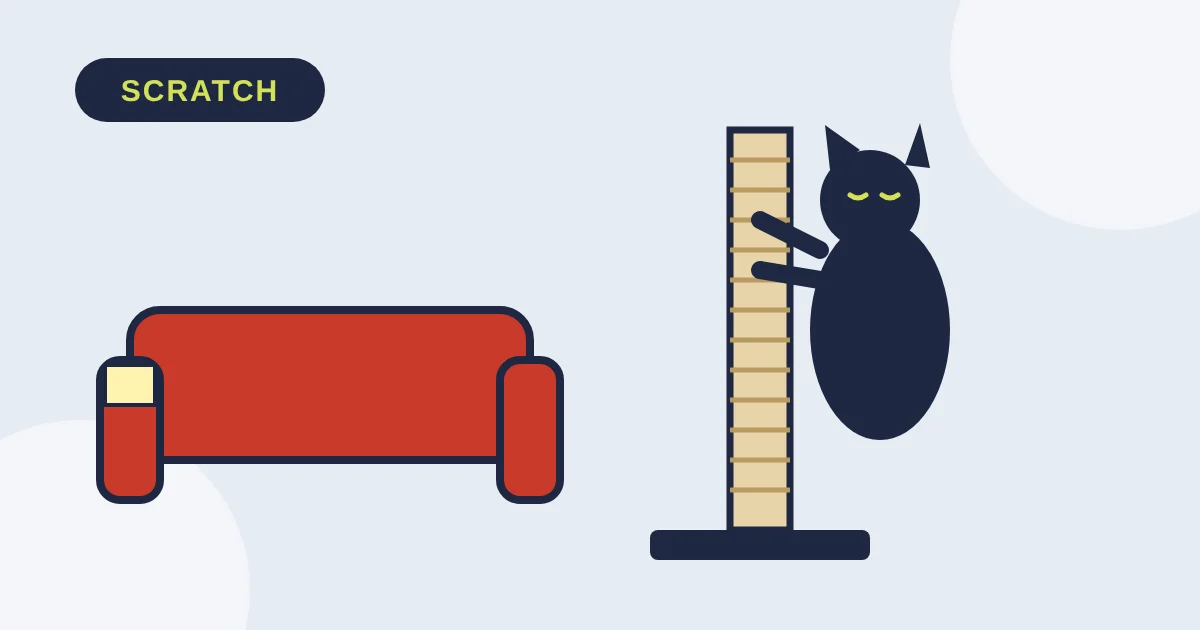
Short answer: you can’t stop a cat from scratching, and you shouldn’t try; you can move it. Put a sturdy, tall sisal post (at least about 30 inches, so your cat can stretch fully) right next to the furniture it scratches, add a horizontal cardboard scratcher for cats who scratch the rug, and make the sofa unappealing for a few weeks with double-sided tape or a throw. Reward every scratch on the post, trim nails regularly, and never punish. Big cats need a heavier base: a post that wobbles once is a post they won’t use again.
A note from Helen: Tim is a big black cat, and big cats stretch long and scratch hard, so a short, wobbly post just doesn’t work for them. This guide isn’t a test of scratchers on Tim. The advice comes from the ASPCA and the American Association of Feline Practitioners (AAFP), and product details and complaints from Amazon listings and their review summaries, checked October 26, 2026.
Why cats scratch furniture
Scratching isn’t bad behavior. It’s how cats shed the worn outer layer of their claws, stretch their back and shoulders, and leave scent from glands in their paws, a message that says “this is my place”. That last part explains why cats pick the sofa by the door or the chair next to their bed: those are the spots that matter to them, in places everyone sees.
So the goal is not to stop scratching. It’s to give your cat something better to scratch, in the same spot.
Match the scratcher to how your cat scratches
Watch your cat for a day. The ASPCA suggests offering several materials and angles, then buying more of whatever your cat prefers.
| Your cat scratches… | Give it | Why |
|---|---|---|
| The sides of the sofa, chair legs, door frames | A tall vertical sisal post | Vertical scratchers stretch the whole body upward |
| The rug, carpet or stairs | A flat or angled cardboard scratcher on the floor | Horizontal scratchers suit cats who pull backward on the floor |
| The mattress or bed | A post or a pad right by the bed | Cats often scratch after waking up |
| Everything | Both: a post and a cardboard pad | Many cats use both |
What makes a good post
- Tall enough for a full stretch. Your cat should be able to reach up with its body straight; for most adult cats that’s about 30 inches or more, and taller for big cats.
- Sturdy. The ASPCA says to choose a post that won’t wobble. A heavy, wide base matters more than any feature.
- Rough material. Sisal rope or sisal fabric gives claws something to grip. Carpet-covered posts feel like the rug, which can confuse the message.
- In the right place. Next to the furniture being scratched, near where your cat sleeps, and by entrances. Not in a back room.
- Keep the old one. A shredded, well-used post smells familiar, and cats often prefer it. Add a new one alongside instead of swapping.
Climbers might be happier with a full cat tree: our guide to cat trees for large cats covers base widths and wall straps.
The 4-week plan to move scratching
| Week | What to do |
|---|---|
| Week 1 | Put the post right against the scratched furniture. Rub it with catnip or dangle a toy on it. Cover the scratched area with double-sided tape or a thick throw. |
| Week 2 | Every time your cat uses the post, praise or give a treat. If it starts on the sofa, calmly carry it to the post or toss a toy there. |
| Week 3 | Once the post is the habit, you can move it a little at a time, a few inches every couple of days, to where you’d like it. |
| Week 4 | Remove the tape or cover once your cat has ignored the furniture for about a week. Keep the post there for good. |
Making furniture less tempting
- Double-sided tape or a throw over the corner your cat uses. The ASPCA also suggests sandpaper or an upside-down carpet runner for floors.
- Trim nails every couple of weeks. Short nails do far less damage.
- Soft nail caps glued over the claws are a temporary option; the ASPCA says they last about four to six weeks.
- Pheromone sprays made to attract scratching can help on a new post.
What not to do
- Don’t punish. Shouting or spraying water can teach your cat to fear you, not the sofa, and the ASPCA treats startling as a last resort.
- Don’t force paws onto the post. Dragging a cat’s claws across it can frighten it away from the post.
- Don’t declaw. Declawing is the amputation of the last bone of each toe. The ASPCA strongly opposes it, and the AAFP opposes it as an elective procedure.
Scratchers worth buying
Affiliate note: some links in this guide go to Amazon. As an Amazon Associate we earn from qualifying purchases, at no extra cost to you. We choose products for fit, safety and specifications, not for the commission.
32″ tall sisal, 16″ × 16″ base.
Check on AmazonMost cats use two scratchers more than one. If you’re waiting for Black Friday, add both to your Amazon cart now so they’re easy to find when deals start.
How I chose
- I looked for the two things the ASPCA stresses: tall enough for a full stretch, and sturdy enough not to wobble.
- I read Amazon’s review topic counts for each on October 26, 2026 and list the complaints.
- Tim hasn’t been tested with these exact scratchers; picks are based on specifications and owner feedback.
Vertical: SmartCat Pioneer Pet Ultimate Scratching Post
A 32-inch post wrapped in woven sisal on a 16 by 16 inch base, assembled with two screws. It’s tall enough for most cats to stretch fully, and its wide base is what keeps it from tipping, the reason this post has been a best seller for years.
- Cats use it: 4,451 of 4,528 pet-attraction mentions positive.
- Height: 1,938 of 2,033 positive.
- Value: 452 of 2,535 mentions negative.
- Durability: 332 of 2,163 negative, the sisal wearing through after heavy use.
- Scratching post: 278 of 3,973 negative.
Skip it if your cat only scratches floors and rugs; get a horizontal pad.
Check it on AmazonHorizontal: PetFusion Cat Scratching Flip Pad
A curved cardboard scratcher about 19.7 by 10.2 inches, with two designs: flip it over when one side wears out. It doubles as a lounge, which many cats like, and it comes with catnip.
- Cats like it: 205 of 223 pet-preference mentions positive.
- Sturdiness: 67 of 68 positive.
- Value: 40 of 148 negative.
- Debris: 15 of 42 negative; cardboard scratchers shed bits.
- Size: 18 of 81 negative; for a big cat, look at the larger version on the listing.
Skip it if your cat scratches upward; it needs a post.
Check it on AmazonChecklist
Stop furniture scratching checklist
Frequently asked questions
How do I stop my cat from scratching the couch?
Put a tall, sturdy sisal scratching post right next to the spot your cat scratches, cover that spot with double-sided tape or a throw for a few weeks, reward your cat every time it uses the post, and trim its nails regularly.
How tall should a cat scratching post be?
Tall enough for your cat to stretch fully with its body straight, which for most adult cats means about 30 inches or more. Big cats need taller posts and a heavier base.
Do cats prefer vertical or horizontal scratchers?
It depends on the cat. Cats that scratch sofas and door frames usually prefer vertical posts; cats that scratch rugs and stairs often prefer horizontal cardboard scratchers. Many cats use both.
Why won't my cat use the scratching post?
Usually it wobbles, it's too short, it's carpet rather than rough sisal, or it's in the wrong place. Move it next to the furniture your cat scratches and make it more inviting with catnip or a toy.
Is declawing a cat okay?
The ASPCA strongly opposes declawing, and the AAFP opposes it as an elective procedure. Scratching posts, nail trims and soft nail caps are the alternatives.
Paws & Picks is a participant in the Amazon Services LLC Associates Program. As an Amazon Associate we earn from qualifying purchases. Product details can change; check the current listing before you buy.
Sources
- ASPCA: Destructive scratching
- AAFP: Living with a clawed cat (guide)
- AAFP: Position statement on declawing
- Amazon product listings and review summaries for the scratchers above, checked October 26, 2026.