 By
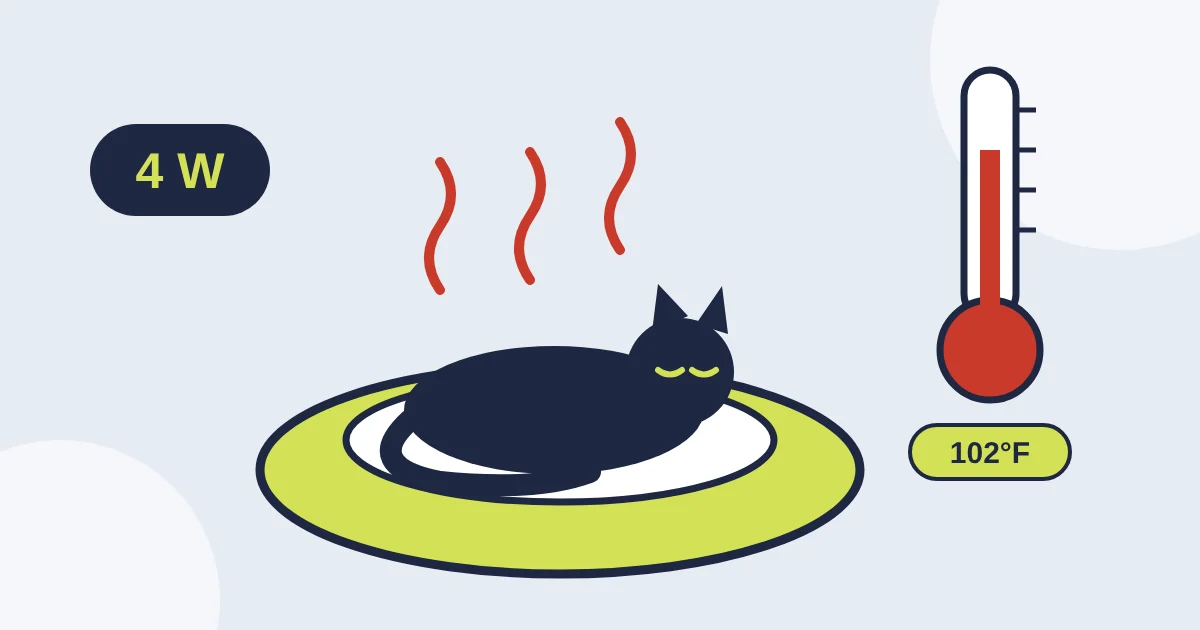
Short answer: yes, a heated cat bed is safe for most indoor cats if it has a thermostat that stops near a cat’s own body temperature, an electrical safety listing, and enough room for the cat to move off the warm spot. Low-wattage pet-activated beds (4 to 6 watts) cost well under a dollar a month to run even if left on all day. For cord chewers, start with a self-warming pad, which uses no electricity at all; for a sick cat or one that can’t move easily, ask your vet first.
A note from Helen: Tim, our big black cat, was the cat I had in mind for this guide, because he will find the one sunny patch in any room. This isn’t a test of beds on Tim. Temperatures come from the Merck Veterinary Manual and a veterinarian’s review, the burn warning from Lort Smith Animal Hospital, energy prices from the U.S. Energy Information Administration, and product details and complaints from Amazon listings and their review summaries, checked October 23, 2026.
Why cats love heat more than we do
Cats are comfortable at temperatures that feel hot to us. In a review for the Veterinary Ireland Journal, veterinarian Dr Aine Seavers (MVB MRCVS) notes that the National Research Council puts a cat’s thermoneutral zone at 30–38°C (about 86–100°F), the range where a cat doesn’t have to spend energy to keep warm. For people it is about 18–25°C (64–77°F). That gap is why cats sleep on sunny windowsills, radiators and laptops, and why, in winter, some climb into tumble dryers or under cars to find heat.
A cat’s normal body temperature is also higher than ours: 100.5–102.5°F (38.1–39.2°C), according to the Merck Veterinary Manual. A good heated bed warms to about that, not more. Dr Seavers adds that cold makes arthritic pain worse.
The three kinds of warm cat beds
| Self-warming pad or bed | Pet-activated heated bed | Adjustable heating pad | |
|---|---|---|---|
| How it heats | No power: a reflective layer, like a space blanket, sends the cat’s own heat back | A low-watt heater with a thermostat that warms when the cat lies on it | A heater you set yourself, often with a timer |
| Typical power | None | 4–6 W indoors; 20–25 W outdoor models | Varies; one best seller offers 11 settings from 80 to 130°F |
| How warm | Only as warm as the cat | About 102°F on K&H’s mat, close to body temperature | Up to well above body temperature on high |
| Cord | No | Yes | Yes; the one we checked has a spiral chew cover |
| Best for | Most healthy cats, cord chewers, carriers and shelters with no outlet | Seniors, stiff cats, cool homes, outdoor shelters | Owners who want to control the heat and will check on the cat |
| Main complaint | Some find the warmth “negligible” | “It doesn’t get warm” (it only warms with the cat in it) | Durability: some stop working |
Are heated cat beds safe?
A well-made pet bed with a thermostat is low risk, but heat sources do cause burns in cats. Lort Smith Animal Hospital in Melbourne lists electric heating pads, along with heat lamps, radiators and stovetops, among the common causes of thermal burns it treats. These are the rules I would follow:
- Choose a thermostat near body temperature. K&H says its Thermo-Kitty Mat warms to about 102°F with a cat on it, within the normal range for a cat’s body. If you buy an adjustable pad, keep it on a low setting; the one we looked at goes up to 130°F.
- Leave somewhere cooler to go. Put the heater under half the bed, or the mat beside an unheated bed, so your cat can move off the warmth. This matters most for cats who can’t move easily.
- Keep the cover on. The adjustable pad’s listing says not to let pets lie on it without its plush cover. K&H’s outdoor pad says the opposite for its own design: don’t cover it with blankets or towels, only its own cover. Follow the instructions for the pad you buy.
- Look for a safety listing. K&H says it safety-certifies the whole product, not just the parts; its outdoor houses are certified by MET Labs. I would avoid unlisted heaters, and I wouldn’t use a human heating pad as a pet bed.
- Cord chewers get a self-warming pad. If your cat chews cables, use a no-cord pad, or run the cord behind furniture and check it for bite marks. K&H’s Extreme Weather Kitty Pad has a steel-wrapped cord for outdoor use.
- Ask your vet first for a cat that is sick, recovering from surgery or can’t get up and move away from heat on its own.
Signs of a burn: Lort Smith lists red, blistered or swollen skin, singed hair with a distinctive smell, and in severe cases charred or peeling skin and shock. Move your cat off the heat, cool the area with water, don’t put creams on it, and see a vet right away.
Which warmer fits your cat, and what it costs to run
Find the right warmer
Answer four questions. The tool suggests a type and works out the running cost of the heated beds in this guide at your electricity price. Nothing you type leaves your browser.
The default price, 18.2 cents per kWh, is the EIA’s 2026 forecast for the average U.S. home (October 2026 Short-Term Energy Outlook). Your bill shows your own rate. Costs assume the heater runs at full power the whole time; a thermostat bed uses less.
The quick math: a 4-watt bed left on 24 hours a day uses about 2.9 kWh a month, about 52 cents at 18.2 cents per kWh. A 6-watt mat costs about 79 cents, and a 20-watt outdoor house about $2.62. A whole five-month winter with the 4-watt bed comes to about $2.60.
“My heated cat bed doesn’t get warm”
This is the most common complaint about pet-activated beds, and usually the bed is working. K&H’s listings say the surface stays at or just above room temperature when the bed is empty and only warms when a pet lies on it, so it won’t feel warm to your hand. Amazon’s review summary for the outdoor house says its pad warms after about 10 minutes of pressure.
- Our test: put a folded towel and something heavy, such as a bag of rice, on the heated spot for 15 to 20 minutes, then feel underneath.
- Check where the heater sits. On the K&H mat, the heater is 20 by 5.5 inches inside a 25 by 12.5 inch mat, so only the middle warms. Several owners mention this in the size complaints.
- Don’t pile blankets on top. A thick blanket between cat and heater means less warmth reaches the cat (and some outdoor pads say not to cover them at all).
- Give it time. Some cats ignore a new bed at first; one owner joked about three weeks. Put it where your cat already naps, and add a piece of clothing that smells like you.
What owners complain about
I looked at Amazon’s review summaries for seven popular warm beds and pads on October 23, 2026. Amazon counts how many reviews mention a topic and whether each is positive or negative.
| Product | Warmth | Other complaints |
|---|---|---|
| K&H Thermo-Kitty Bed, 4 W (our pick) | 212 of 766 heat mentions negative (28%) | Size: 55 of 140 negative |
| K&H Thermo-Kitty Mat, 6 W (our pick) | 492 of 1,565 negative (31%) | Size: 151 of 249 negative (heater smaller than the mat) |
| K&H Self-Warming Pad (our pick) | 90 of 579 negative (16%) | Durability: 77 of 165 negative; some say it sheds |
| Mora Pets Self-Warming Mat (our pick) | 141 of 1,127 negative (13%) | Self-heating: 71 of 220 say the effect is small |
| K&H Outdoor Heated Kitty House (our pick) | 97 of 508 temperature mentions negative | Weather resistance: 81 of 163 negative; not for open rain and snow |
| K&H Thermo-Snuggle Cup (not picked) | 96 of 380 negative | “Flimsy”: 84 of 99 negative; sides collapse |
| Adjustable heating pad, 80–130°F (not picked) | 27 of 97 heating mentions negative | Durability: 46 of 82 negative |
The pattern: cats like nearly all of them (pet-preference scores are above 90% positive for every pick). Electric beds draw “not warm enough” complaints because they are designed to stay gentle, and self-warming pads because they can only return the cat’s own heat.
Beds and pads worth buying
Affiliate note: some links in this guide go to Amazon. As an Amazon Associate we earn from qualifying purchases, at no extra cost to you. We choose products for fit, safety and specifications, not for the commission.
Cold nights are coming. If you’re waiting for Black Friday, add the one that fits your cat to your Amazon cart now so it’s easy to find when deals start.
How I chose
- For electric beds, I only picked ones with a thermostat and an electrical safety listing, and a stated wattage.
- I weighed Amazon’s review summaries for warmth, durability and size, and read why owners say a bed “doesn’t get warm”.
- I left out a popular adjustable pad because its top setting, 130°F, is far above a cat’s body temperature, and a bed with collapsing sides.
- I checked every listing on October 23, 2026 for stock and U.S. delivery. Picks are based on specifications and owner feedback, not on tests with Tim.
Best heated bed: K&H Thermo-Kitty Bed
A round bed with 6-inch soft foam walls and a removable 4-watt thermostatic heater that warms only when your cat is inside. It comes in two sizes: Small, 16 inches, for cats under 15 pounds, and Large, 20 inches, for cats over 15 pounds. Take the heater out in summer and it is an ordinary bed.
- Cats like it: 1,071 of 1,166 pet-preference mentions positive; one owner says it works for both large and medium cats.
- Machine-washable cover once the heater is out.
- About 52 cents a month even if left on all day.
- Heat: 212 of 766 mentions negative, mostly that it doesn’t feel warm (see the test above).
- Size: 55 of 140 negative; get the 20-inch bed for a big cat.
Skip it if your cat chews cords; choose a self-warming pad.
Check it on AmazonHeat any spot: K&H Thermo-Kitty Mat
A flat, reversible 25 by 12.5 inch mat with a removable 6-watt heater (20 by 5.5 inches) under soft foam. K&H says it warms to about 102°F when your cat lies on it. Use it alone, on a windowsill, on top of your cat’s favorite bed or on a cat-tree shelf. Owners say it is especially good for older cats.
- 800+ bought in the past month.
- Flat, so stiff cats can step on without climbing a wall.
- Washable cover.
- Warmth: 492 of 1,565 negative. Some say it doesn’t get warm at all, others that it is plenty warm.
- The heater covers only the middle strip of the mat.
Skip it if your cat likes to curl up surrounded by walls; choose the bed.
Check it on AmazonNo cord: K&H Self-Warming Pad
A 21 by 17 inch plush pad with a reflective layer that sends your cat’s body heat back. No electricity, no cord, nothing to overheat. It’s the #1 cat bed mat on Amazon, with more than 7,000 bought in the past month and 13,000+ ratings.
- Warmth: 489 of 579 mentions positive.
- Owners say it works in outdoor cat houses too.
- Reversible plush sides.
- Durability: 77 of 165 negative; some say it sheds.
- It makes a slight crinkle sound, which K&H says most cats like but noise-shy cats may not.
- Size: 54 of 159 negative; smaller than some expected.
Skip it if your cat is spooked by crinkly sounds; choose Mora Pets.
Check it on AmazonBigger, no crinkle: Mora Pets Self-Warming Mat
A self-heating mat with a carbon-infused cover and a noiseless reflective film, in three sizes: 24 by 18, 29.1 by 18.9 and 35 by 23.6 inches. The cover zips off and is machine-washable. Owners say it’s big enough for cats to share.
- Warmth: 986 of 1,127 mentions positive.
- No crinkle sound.
- 3,000+ bought in the past month.
- Self-heating: 71 of 220 say the effect is small.
- Value: 143 of 475 negative.
Outdoor cats: K&H Outdoor Heated Kitty House
An insulated 19 by 22 by 17 inch shelter with a 20-watt MET-listed waterproof heated bed inside, and two 6 by 8 inch exits with clear flaps, so a cat is never trapped by a predator. It’s for community and feral cats, porches, garages and barns.
- Cats use it: 756 of 784 pet-happiness mentions positive.
- Owners say it holds up through full winters.
- About $2.62 a month at full power.
- Weather resistance: 81 of 163 negative. Put it under a roof, not in open rain or snow.
- Like all K&H heaters, it only warms with a cat inside.
Skip it if there is no outdoor-rated outlet nearby; put a self-warming pad in an insulated shelter instead.
Check it on AmazonSetup checklist
Heated cat bed setup checklist
Sofa under attack? Our guide to stopping furniture scratching has a 4-week plan.
Frequently asked questions
Are heated cat beds safe?
Pet heated beds with a thermostat and an electrical safety listing are low risk for healthy cats. Choose one that warms to about a cat’s body temperature (K&H says its mat reaches about 102°F), leave an unheated spot so your cat can move away, and keep cords away from chewers. Lort Smith Animal Hospital lists electric heating pads among causes of burns in cats, so ask your vet first for a sick cat or one that can’t move easily.
Can I leave a heated cat bed on all the time?
Pet-activated beds like K&H’s are designed to stay plugged in: the listings say they stay at about room temperature when empty and warm only when your cat lies on them. Check the cord regularly and follow the maker’s instructions.
How much electricity does a heated cat bed use?
Very little. A 4-watt bed left on all day uses about 2.9 kWh a month, about 52 cents at the EIA’s 2026 average U.S. price of 18.2 cents per kWh. A 20-watt outdoor house costs about $2.62 a month at full power.
Why doesn’t my heated cat bed feel warm?
Most pet-activated beds only warm when a pet lies on them, so they feel cool to your hand. Test it by putting a folded towel and a heavy bag of rice on the heated spot for 15 to 20 minutes, then feel underneath.
Are self-warming cat beds as good as heated ones?
They are safer and free to run, but they can only reflect your cat’s own body heat, and some owners find the effect small. For a senior cat or a cool home, a low-watt heated bed gives more warmth.
What temperature should a heated cat bed be?
Close to a cat’s normal body temperature, which the Merck Veterinary Manual gives as 100.5 to 102.5°F. Avoid running adjustable pads on their highest settings; the best seller we checked goes up to 130°F.
Paws & Picks is a participant in the Amazon Services LLC Associates Program. As an Amazon Associate we earn from qualifying purchases. Product details can change; check the current listing before you buy.
Sources
- Aine Seavers, MVB MRCVS: The heat is on: the feline thermoneutral zone, Veterinary Ireland Journal (April 2023)
- Merck Veterinary Manual: Normal rectal temperature ranges
- Lort Smith Animal Hospital: Burns (thermal) in cats
- U.S. Energy Information Administration: Short-Term Energy Outlook, electricity (October 2026)
- Amazon product listings and review summaries for the beds and pads above, checked October 23, 2026.